
In continuing coverage about the public hearing for Sunset Hills development.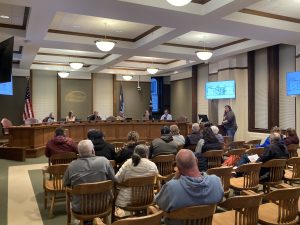
For Sunset Hills development, there are action steps for the rezoning and plat. Rezoning requires two meetings at the city council. At the April 6 Hastings City Council meeting, there will be a reading for the rezoning, and this item may be found in the consent agenda. The plat, development, and rezoning as a whole will be before the city council on April 20, 2026.
To gain insight regarding resident concerns about the Sunset Hills development. KDWA connected with Community Development Director John Hinzman. During the public hearing at the (March 23) planning commission meeting, a resident referenced a survey pertaining to development, and the resident inquired about the change of development plans.
Director Hensman addresses this and offers clarity.
“Yeah, in 2024 we did a small area plan for the greater area of Highway 55 and Jacob. This was an area that went from the current city limits up to Featherstone Road, west to Jacob Avenue, and then down to nearly county road 46. So we’re looking at about 400 acres altogether, and the property that we were talking about where Sunset Hills is was part of that project area. And so, the purpose of the study was to determine future land use for properties that would be annexed into the city. Most of these properties are outside the city at present. The one that we have with Sunset Hills is one of those exceptions; it was presently in the limits but essentially to give developers direction as to what the city would accept. So, it was a higher-scale land-use overview to determine whether something should be commercial, something should be low-density residential, medium-density residential, or whatever. And so that was the purpose of it was to guide future development. The plan itself was not a conceptual plan of how it would develop on individual properties but more to give guidance on how the density would be established if properties were to come in. So, on this property for Sunset Hills, that was designated as low density. And that’s consistent with our comprehensive plan, and then consistent with the plan that Jablonski came forward with.”
Another concern was housing density. Hinzman speaks to this concern.
“Yeah, I mean, from the housing density standpoint, it’s about 3.4 units an acre. On that one, the density is slightly more than the residential development directly to the east of it. When you count that with the town homes that are there already, the twin homes that are on Seed Court, my guess is it probably will be pretty comparable on that one. It’s, the lot sizes are a little bit smaller on that one, but the density is within the range of what we determined to be low density in our comprehensive plan.”
John Hinzman addresses the traffic concerns pertaining to additional housing units.
“Yeah, with 14th Street, that would be what we call a temporary cul de sac. So, there’s about 12 lots that would be created with the second phase of this development that would front, off of 14th Street as it’s extended. And then if development was to occur in the future beyond this development to the west, then 14th Street would be extended there. When a review would occur for that future development on it, one of the things we would be looking at would be what the impact would be to 14th Street in the future, and so it’s certainly a valid concern that I can’t answer at this point as far as what that impact would be. I mean, I don’t anticipate 14th Street being it’s not designed to be a collector street by any means. It would be extended into this development to the west at some point, and then it would be, I would presume, feed it off some way or the other so that it would not be a through road or wouldn’t be a desirable connection to get back, that we would try to generate the traffic going more towards 55 from that development. So understand that there’s not certainty towards that at this point. I could speak to this development in particular; there to be, I think, 12 to 14 homes that would be added to 14th Street and 14th Street’s traffic that goes down there. It’s designed to adequately handle that. So, what, we don’t have any concerns about the adequacy of that. Understand that there’ll be a few more trips that will go down there.”
There was a suggestion at the public meeting for a traffic study. Hinzman offers insight.
“Yeah. I mean, we don’t have a hard and fast rule as to when a traffic study would occur. I know, with the state rules for environmental assessment, which includes a traffic study, it would be, have to be a residential development in excess of 350 housing units, and so, I mean, this is 26. So it’s significantly less than the state threshold that would require a traffic study. But generally, we would require that in less in smaller developments, if there’s traffic issues that have been presently identified or if there’s going to be a concentration of traffic in a particular area. With this development here, the number of homes we’ve got, 14 going up one way and 13 or 14 going up another, we don’t see that as significant, and it certainly doesn’t meet the minimum qualifications that we’ve established previously for doing traffic studies.”
About the existing low water pressure within the Sunset West neighborhood, residents were concerned about how additional homes would affect the water pressure. Hinzman addresses this topic.
“Yeah, I did talk to the city engineer about that a few minutes ago, when I was up at a meeting with him. He does not think that this is going to have any more significant impact on existing homes. So, the creation of these 26 home sites should not impact the water pressure any differently than it is today.”
[Click the soundbite to listen to the broadcast.]